
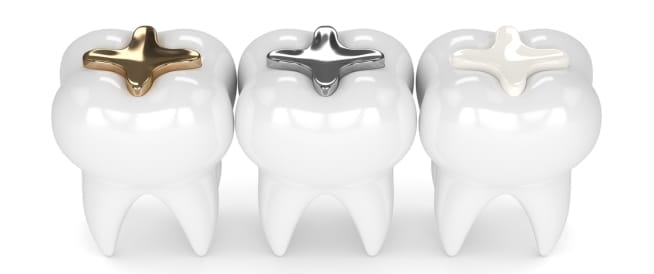

Below are the pros and cons of dental inlays and onlays for back teeth that have cavities or tooth decay.– They cover a wider surface area, but choosing between them depends mainly on the shape and extent of the cavity. – Onlays are used for larger cavities that extend deeply into the tooth’s crown and dentin. – A full dental crown tends to cover the entire tooth, providing more comprehensive protection. – Inlays and onlays are generally more effective than regular fillings for restoring deep cavities. – A dental liner/base is well-suited for deep cavities that have not reached the tooth’s root. – Fillings offer good coverage for smaller cavities. – Inlays and onlays are more appropriate for deep cavities that have not yet affected the root. – An onlay covers most of the tooth’s crown, but not the entire tooth. – It only covers the top (chewing) surface of the tooth, so a full crown still provides more complete coverage in comparison.Read also: What Causes Tooth Discoloration and What Are the Solutions and Treatments?
Traditional Fillings vs. Inlays and Onlays
Tooth decay may not seem like a serious problem at first, but it progressively worsens over time and can eventually threaten the integrity of the tooth.How does decay develop? When teeth are not cleaned properly, dental plaque builds up on their surfaces. This plaque acts as a food source for bacteria, which in turn produce acidic waste products that erode the enamel—the hard outer layer of the teeth.What are dental fillings? Fillings are the first line of defense against tooth decay. Dentists typically use tooth‑colored composite resin or dental amalgam (a mixture of liquid mercury and powdered metal alloys). Composite resin is more aesthetically pleasing, while amalgam is more durable in certain conditions.To place a filling, the dentist first removes the decayed portion of the tooth, then restores the prepared area with either tooth‑colored composite (more natural‑looking) or amalgam (more long‑lasting).Fillings are best suited for small cavities. They can last for many years depending on oral hygiene and aftercare once decay has begun. However, as the cavity becomes larger, traditional fillings become less effective compared to inlays and onlays.Read also: What Do You Need to Know About Gaps Between Teeth?
How Are Inlays and Onlays Done?

The procedure focuses on removing the damaged tooth structure and sealing the area with a custom‑made, tooth‑colored porcelain restoration that is bonded in place to create a smooth, gap‑free interface.The affected area is first numbed with a local anesthetic. The decay or damaged portion of the tooth is then carefully drilled out and cleaned to create a stable base. Next, a dental impression (mold) of the prepared cavity and tooth is taken using a special impression material.This impression is sent to a dental laboratory, where a custom porcelain inlay or onlay is fabricated. In the meantime, a temporary restoration or temporary crown is placed over the prepared tooth for protection.At the next visit, the temporary restoration or crown is removed and the fit of the inlay or onlay is checked. If the fit is not ideal, minor adjustments and smoothing are done. Once there is a precise fit between the damaged tooth and the inlay/onlay, a dental cement or strong resin‑based adhesive is used to permanently bond the restoration into the cavity.The treatment is completed by polishing the new restoration to blend smoothly with the natural tooth structure.Read also: Protecting Oral Health | Identifying Dental EmergenciesBatal Dental Center in Saudi Arabia is one of the oldest and most renowned world‑class dental centers in the region. Please contact them to receive the best available treatment options.