
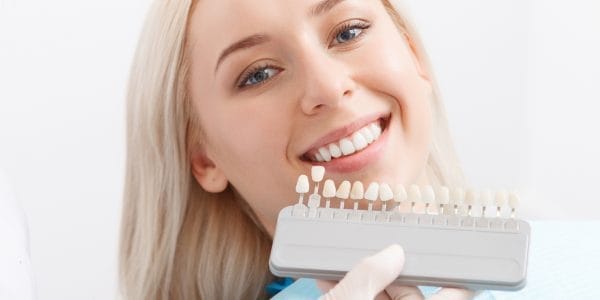

Dental contact lenses are ultra-thin ceramic shells that cover the front surface of the teeth. They are known by this name because of their very slim structure. They transform stained, chipped, worn, or poorly positioned teeth and quickly enhance the smile in a natural way, without damaging the tooth structure, thereby preserving its strength and allowing you to continue eating normally and comfortably.Read also: Everything You Need to Know About Air-Flow Teeth Cleaning
How Dental Contact Lenses Are Applied
Dental contact lenses are very easy to apply. The procedure only requires measuring the patient’s teeth dimensions, tooth sizes, and jaw size, then designing veneers that accurately match the color, shape, and size of natural teeth.Treatment with dental contact lenses starts by minimally preparing the tooth surface, then taking an impression to fabricate a custom porcelain veneer. It is made according to the texture, shade, and brightness agreed upon by the dentist and the patient.The veneers are then bonded to the front surface of the tooth. The results are impressive and fast: in as few as two visits, the patient can achieve a beautiful, natural-looking smile and teeth that appear unworn, while also protecting the enamel. The procedure is painless and very comfortable for the patient.These lenses are used to modify the size, shape, color, and even the position of the teeth, helping patients gain more self-confidence and a greater desire to smile.Read also: Dental Care for Seniors | Information and Details
Contraindications for Dental Contact Lenses
Situations in which dental contact lenses may not be recommended include the following:Read also: Protecting Oral Health | Identifying Dental Emergencies
Types of Dental Veneers
People who suffer from dental problems often wonder which type of veneer is best for them, as veneers differ in material, thickness, and properties. Among the most common types are:Dentists usually recommend these types because they are easy to apply, have an attractive shade and reflection, and closely mimic the translucency and color of natural teeth.Dentists also recommend them because of their natural appearance, their ability to properly reshape teeth, and their effectiveness in closing gaps between teeth.Moreover, one key advantage of veneers is that their thickness does not exceed about 0.3 mm, making them extremely thin—very similar to soft contact lenses used to correct vision problems.This characteristic has made dental contact lenses one of the most popular cosmetic dental treatments worldwide. In many cases, they are used as a good alternative to orthodontic treatment, which usually requires a long treatment period and multiple visits to the dental clinic. These cosmetic veneers can also be used to close gaps between teeth, improve their appearance, and provide a near-permanent whitening effect.It is important to consult the dentists at Batal Dental Center to determine the most appropriate treatment and to ensure you achieve the smile you are looking for.Read also: What You Need to Know About Gaps Between Teeth
Cost of Dental Contact Lenses
In general, the cost of dental contact lenses depends on several factors, including:Based on these various factors and according to our assessment, Batal Dental Center stands out as one of the best options overall. Despite having a highly skilled medical team, its prices are not considered excessively high. For this reason, we recommend consulting the dentists at Batal Center in Saudi Arabia and visiting the clinic.Read also: What Is Composite Resin | Why Do We Need Composite Fillings?
Frequently Asked Questions
How long do dental veneers last?
Most types of dental veneers are made from ceramic or porcelain. They are expected to last around 10–20 years, despite being extremely thin layers.
What is the difference between monthly and yearly lenses?
The main difference between daily and monthly lenses is that daily disposable lenses are more comfortable and convenient for many people: they are worn once per day and then discarded, so there is no need for regular cleaning or disinfection with contact lens solutions. In contrast, monthly lenses are reusable and must be cleaned and stored properly every day.