
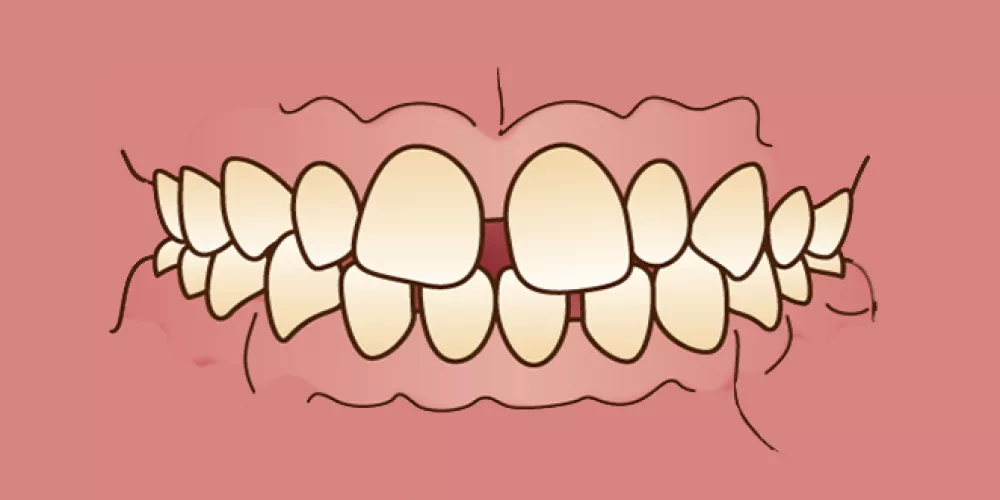

Malocclusion occurs when the teeth are misaligned, and if left untreated, it can lead to a number of oral health complications. You may also see it referred to as:When teeth are out of alignment, they may not be able to perform essential functions properly, such as chewing. Ideally, the teeth should fit comfortably in the mouth without issues of crowding or excessive spacing, and they should not be twisted or rotated.The upper teeth should slightly overlap the lower teeth so that the pointed cusps of the upper molars fit neatly into the grooves of the lower opposing molars. A dentist at Batal Dental Center in Saudi Arabia can help ensure that your upper and lower teeth are properly aligned.Read also: Jaw Pain from Wisdom Teeth | Causes, Home Remedies, and When to See a DentistWhat causes dental malocclusion? In most cases, malocclusion is a hereditary condition, meaning it can be passed down from one generation to the next. However, certain conditions or habits can alter the shape and structure of the jaws. These include:Read also: Everything You Need to Know About Deep Dental Cleaning
What Are the Symptoms of Dental Malocclusion?
Typical symptoms of dental malocclusion include:
Diagnosis and Classification of Malocclusion
Malocclusion is usually diagnosed during routine dental checkups. The dentist will examine your teeth and may take dental X‑rays to determine whether your teeth and jaws are properly aligned.If the dentist detects malocclusion, they will classify it according to its type and severity. There are three main classes of malocclusion:
Class I
Class I malocclusion is diagnosed when the upper and lower molars fit together in a normal relationship, but the other teeth are either crowded or spaced too far apart.In this type of malocclusion, the bite is generally normal and the misalignment of the teeth is not severe. Class I is the most common form of malocclusion.
Class II
Class II malocclusion is diagnosed when there is a significant overbite. In this type, the upper teeth and jaw markedly overlap the lower teeth and jaw.
Class III
Class III malocclusion is diagnosed when there is a pronounced underbite. In this type, the lower teeth extend beyond the upper teeth.This type is usually caused by an enlarged lower jaw, meaning the lower jaw protrudes forward.Read also: Can Invisalign Correct Overbites and What Should You Know About It?
How Is Dental Malocclusion Treated?
Many people with mild malocclusion do not need treatment. Depending on the type and severity of the malocclusion, an orthodontist may recommend different treatment options, which can include:Treating malocclusion can sometimes lead to certain complications, such as:Read also: The Purpose of Dental Veneers and How Long They Last
Can Dental Malocclusion Be Prevented?

Preventing malocclusion can be difficult because most cases are largely genetic.However, jaw and tooth development can also be influenced by environmental factors.Pacifier use should be limited to help reduce changes in jaw growth. Children should also be encouraged to stop thumb‑sucking.Early detection of malocclusion can help reduce the duration and intensity of treatment. Orthodontic specialists at Batal Dental Center in Saudi Arabia can correct malocclusion in both children and adults and achieve excellent results, so do not hesitate to visit.Read also: Dental Implant Recovery Time and Everything You Need to KnowBatal Specialized Dental Complex in Jeddah, Saudi Arabia, is considered one of the leading dental centers, equipped with advanced tools and technologies to help anyone suffering from tooth pain get relief in the hands of highly skilled dentists. Do not delay booking an appointment at the dental clinic in Batal Specialized Complex.Read also: Enamel Erosion | Causes, Diagnosis, and Treatment