
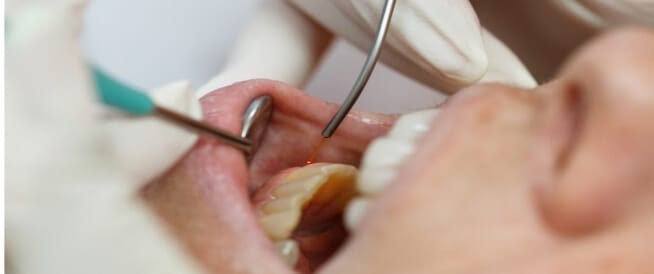

Recent research has suggested that lasers may be used to regenerate tooth enamel. For periodontists, laser technology can be one of the most advanced and precise tools for performing many dental procedures.The team at Batal Dental Center in Saudi Arabia is ready to help prevent dental diseases and manage related conditions using a full range of treatments. It is recommended to visit the center, as it has a highly skilled and experienced medical staff in this field.Read also: The Difference Between a Gum Abscess and a Tooth Abscess
Laser Gum Treatment Basics
A periodontist is actually a type of dentist who specializes in diseases of the gums and supporting structures of the teeth. These dental specialists focus on diagnosing, treating, and preventing periodontal disease.Gum disease develops when the tissues that hold the teeth in place become infected.When bacteria accumulate as plaque due to not flossing and not brushing properly, this plaque eventually hardens into tartar (calculus).Once tartar adheres to the teeth for long periods, tooth decay can develop.Without regular professional cleaning, gum disease can progress and lead to gingivitis, tooth loss, gum recession, and pain while chewing.It is the periodontist’s role to prevent gum disease from developing or to treat patients who are already experiencing symptoms of periodontal disease.Read also: Learn the Difference Between Dental Calculus and Plaque
Uses of Lasers in Treatment
Lasers are used to treat a wide range of dental problems such as tooth decay, gum disease, biopsies and lesion removal, and teeth whitening.Laser therapy offers several important advantages that are hard to achieve with conventional methods:Low‑level laser energy can be used to disinfect periodontal pockets in patients with gum disease.This technique uses a photo‑activated dye (PDT/PAD – Photo‑Activated Disinfection), which is highly effective in killing bacteria.One of the major benefits of this approach is that it can be more effective than antibiotics.The dye used in PAD can be formulated to target specific types of bacteria. This makes it more efficient than broad‑spectrum antibiotics, to which bacteria may already be resistant.After tooth extractions or root canal treatment, low‑level laser therapy is considered an excellent option. According to specialists, it can be highly effective in managing post‑operative pain caused by bacteria and inflammation.The primary use of lasers in periodontal therapy is to eliminate bacteria within the gums, which are often responsible for bleeding and pain in patients with gum disease.This is part of a standard procedure known as gum debridement. However, using lasers makes this process more efficient when assisting with scaling and root planing, and laser techniques have been shown to significantly reduce bleeding.In addition, there is a much lower risk of recurrent chronic gum disease compared with using manual techniques alone.Scaling and root planing work together as a non-surgical treatment approach when someone is suffering from chronic periodontitis. These procedures typically involve:– Thoroughly cleaning below the gumline (scaling) – Smoothing the root surfaces (root planing) to help the gums reattachLasers also play a major role in soft tissue removal, especially in a protocol known as Laser-Assisted New Attachment Procedure (LANAP). In the past, this often required invasive and painful surgery.Now, lasers can gently remove diseased tissue much more comfortably. As with other laser procedures, patients usually experience faster healing times and less discomfort afterward.Since many patients with gum disease have uneven or misshapen gums, dentists can use laser gingivectomy or gum contouring to reshape the gumline and improve both function and appearance.Read also: The Most Important Causes of Gum Recession
Strengthening Teeth Through Laser Gum Treatment
Laser technology can also help strengthen teeth. Whether the goal is to make teeth more resistant to cavities or to protect them against decay (a common consequence of gum disease),some of the latest laser techniques can alter the chemical structure of the tooth by using specific wavelengths and pulse settings.One study showed that a carbon dioxide (CO₂) laser can convert the usual carbonated hydroxyapatite in tooth enamel into purer hydroxyapatite.This form of hydroxyapatite has greater resistance to the acids produced by bacteria. When researchers evaluated patients who had undergone laser procedures a year earlier, they found fewer signs of tooth decay than before treatment.If you are looking for an effective way to solve dental problems or considering how best to help someone with oral health issues, Batal Dental Center in Saudi Arabia can be an excellent choice, thanks to its outstanding medical team covering all dental specialties.Read also: Why Are Gums Black and What Causes Gum Discoloration?The dental clinic at Batal Specialized Complex is equipped with advanced tools and devices to help anyone suffering from tooth or gum pain get relief in the hands of highly competent dentists. Do not hesitate to book an appointment at the dental clinic of Batal Specialized Complex.Read also: Tooth Enamel Erosion: Causes, Diagnosis, and Treatment