
How do I choose between dental implants and crowns? The complete guide to making the right decision

How do I choose between dental implants and dentures/bridges?
Your choice between dental implants and prosthetic restorations (such as fixed bridges or removable dentures) depends on several medical and personal factors that should be discussed with your dentist after a thorough examination of your mouth and jawbone.
Dental implants are often the preferred option when jawbone density is adequate and there are no uncontrolled systemic conditions, because they replace the lost tooth root itself, provide excellent stability, look very natural, and help preserve jawbone volume in the long term.
Fixed or removable prostheses, on the other hand, may be more suitable if you have significant bone loss that does not allow for implants, are on a tighter budget, or prefer a solution that is quicker and less invasive in terms of treatment time.
When choosing between implants and prosthetic restorations, your dentist will consider the number of missing teeth, the health of your gums, lifestyle habits such as smoking, as well as cost, treatment duration, and the level of care needed after the procedure.
The best decision is made in consultation with a prosthodontist or a dentist experienced in restorative dentistry, who can clearly explain the advantages and limitations of each option in light of your specific case, helping you reach a treatment plan that offers an attractive appearance, comfort, and safe, efficient chewing function.
What’s the difference between dental implants and dental prostheses?
What are dental implants?
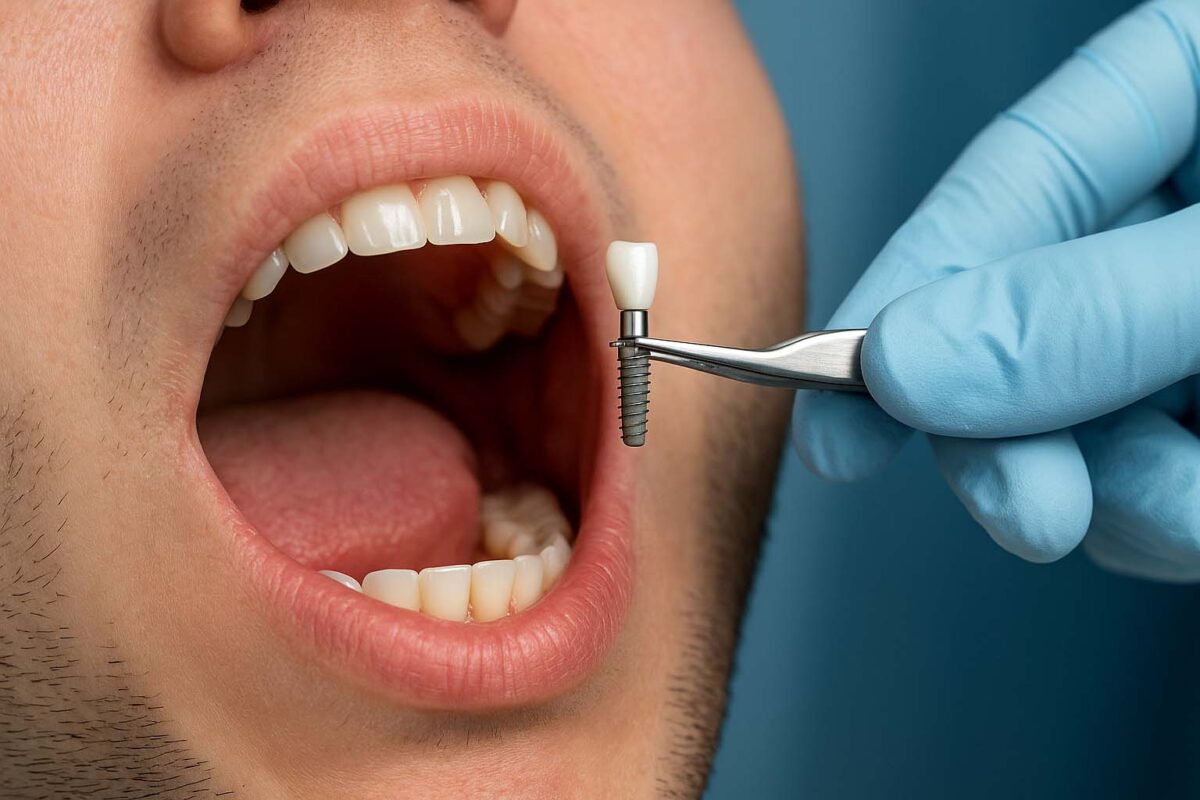
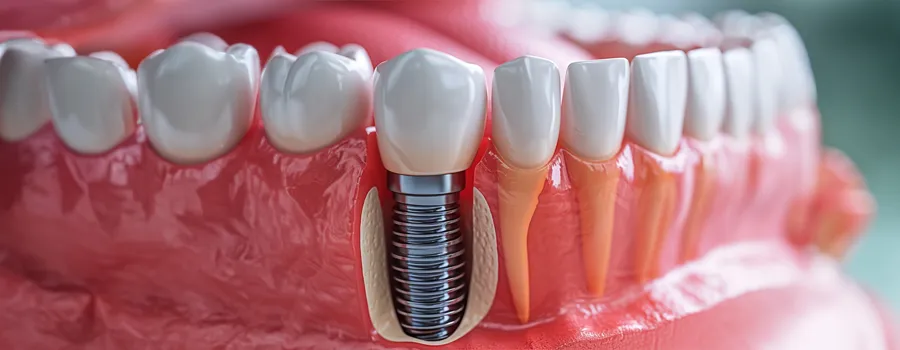
Dental implants are a long‑term solution used to replace one or more missing teeth by inserting a titanium artificial root into the jawbone, then placing a crown on top that mimics the natural tooth in shape and function.
Implants are considered the closest option to a natural tooth in terms of appearance, function, and stability. This is what fundamentally distinguishes them from conventional removable or fixed prostheses.
When comparing dental implants with traditional prosthetic options, an important advantage of implants is that they do not rely on neighboring teeth for support. Instead, they integrate directly with the jawbone (osseointegration), which helps preserve bone volume and reduces bone resorption over time.
Dental implants also provide greater comfort and chewing efficiency and allow patients to speak more confidently — a key consideration when deciding between implants and other types of dental prostheses for each individual case.
What are dental prostheses (dental restorations)?
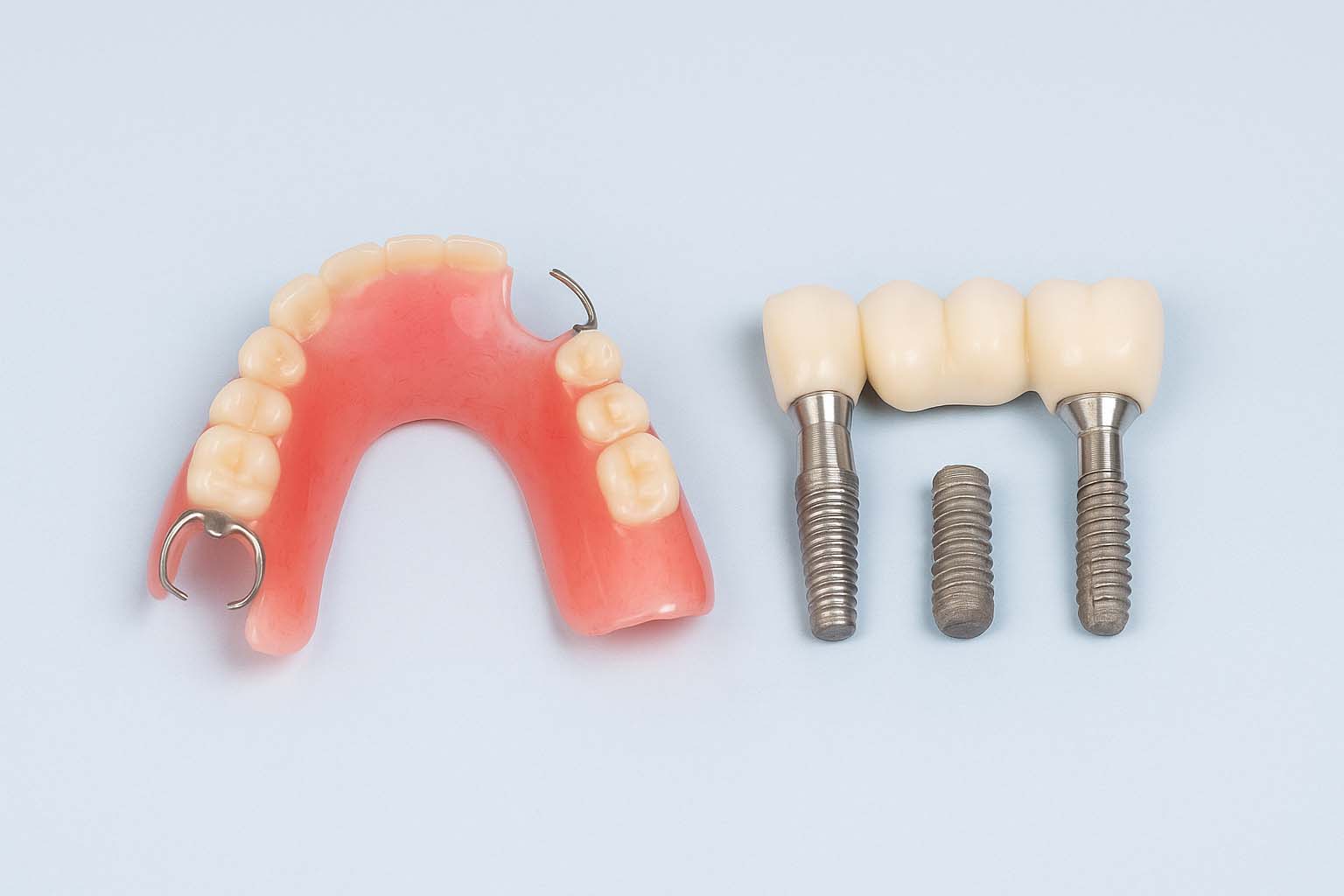
Dental prostheses are restorative solutions designed to replace missing teeth and close the resulting gaps. They can be fixed, such as dental bridges, or removable, such as partial or complete dentures.
Unlike implants, many prosthetic options depend on adjacent teeth or the gums for retention and support, which may sometimes require preparation and reduction of otherwise healthy teeth to accommodate the prosthesis.
When exploring the difference between dental implants and prosthetic restorations, it’s important to understand that prostheses are often less expensive and quicker to deliver. However, they may offer less stability and comfort over the long term and may need periodic adjustment or replacement.
Dental prostheses are a common choice for patients whose general health or jawbone condition does not allow for implant placement, or for those seeking an acceptable replacement option within a more limited budget.
A quick comparison between the two options
When comparing dental implants with prosthetic restorations, implants generally provide superior stability, a more natural appearance, and help maintain the jawbone. On the other hand, they require a surgical procedure, a longer treatment period, and relatively higher costs.
By contrast, dental prostheses are usually less invasive, faster to deliver, and often more affordable. However, they may be less comfortable and less stable, can place additional load on adjacent teeth, and may become loose or move over time.
Your choice between dental implants and prosthetic restorations depends on your overall health, the amount and quality of bone in your jaw, the number of missing teeth, your budget, and your expectations regarding aesthetics and comfort.
Understanding these differences allows you to discuss your options clearly with your dentist and reach a treatment decision that genuinely matches your needs, instead of relying solely on cost or how popular a given option is.
When Are Dental Implants the Best Option?
When a single tooth is missing
When only one tooth is lost, dental implants are often the best option compared to conventional fixed prostheses.
A fixed prosthesis (bridge) requires preparing and trimming the adjacent healthy teeth to support the bridge, which can weaken otherwise intact teeth.
In contrast, a dental implant is anchored directly into the jawbone as an artificial root, and a crown is then placed on top that closely mimics a natural tooth in shape, color, and function.
This way, dental implants preserve the surrounding teeth, provide a long‑term solution, and help maintain chewing efficiency and a harmonious smile.
When you want a long‑term solution
When are dental implants the better choice?
If you are looking for a long‑lasting solution to tooth loss, dental implants clearly outperform removable dentures and conventional bridges.
With proper oral hygiene and regular follow‑up, dental implants can last for decades, whereas removable prostheses typically need to be relined, adjusted, or replaced every few years.
Because implants are firmly integrated into the jawbone, they offer superior comfort and stability, without the worry of a denture moving or dislodging while speaking or eating.
For these reasons, dental implants are considered a long‑term investment in oral health, masticatory function, and overall quality of life.
When there is adequate jawbone
One of the key factors that makes dental implants the optimal choice is having sufficient height, width, and density of jawbone in the area of the missing tooth.
The implant procedure depends on the osseointegration of a titanium fixture with the surrounding bone, allowing it to act as a stable artificial root for the new tooth.
When the bone volume and quality are favorable, implant success rates are very high compared with other treatment options.
If there is bone loss or insufficient bone volume, the patient may first require adjunctive procedures such as bone grafting or ridge augmentation before implant placement is considered.
For this reason, the dentist evaluates the jawbone using radiographs, and often 3D imaging (CBCT), to determine whether dental implants are the most appropriate option.
For those seeking maximum stability
Dental implants are the preferred option for patients who prioritize maximum stability during eating, speaking, and smiling.
Removable dentures may shift, cause sore spots, or feel unstable, particularly over time or in the presence of progressive bone resorption.
In contrast, implants are anchored within the jawbone in a manner similar to natural tooth roots, providing a much greater sense of security and confidence.
This advantage is especially important for individuals who struggle to adapt to removable dentures or feel self‑conscious about the possibility of their prosthesis moving in social situations.
Therefore, many patients choose dental implants when their main goals are stability, comfort, and a natural appearance.
When Are Dental Prostheses the Best Option?
When Faster Treatment Is Needed
Dental prostheses (such as bridges and dentures) are often the most suitable option when a patient needs to replace missing teeth within a relatively short time compared with dental implants.
In many cases, fixed or removable prostheses can be completed within a few weeks after taking impressions and preparing the abutment teeth, without the long waiting period required for osseointegration as in implant therapy.
This makes prosthetic solutions a practical choice when a quick restoration of the smile is important—before major events, for example, or when the patient finds it difficult to live with visible gaps for an extended period.
Many patients also prefer this option when they do not wish to undergo surgical procedures or cannot commit to a lengthy treatment plan.
When Suitable Abutment Teeth Are Present
Prosthetic treatment is often the best option when there are strong, healthy natural teeth that can serve as abutments for fixed bridges or other restorations.
In such situations, the dentist can carefully prepare the teeth adjacent to the gap, then cement a fixed prosthesis that replaces the missing tooth or teeth, providing very good stability and satisfactory chewing function.
Having suitable abutment teeth may reduce the need for placing an individual implant for every missing tooth, especially when the jawbone is weak or would require complex bone grafting procedures.
In this way, dental prostheses offer an effective and less complex alternative to implants, while maintaining an acceptable aesthetic appearance and functional stability over the medium to long term.
In Certain Cases of Multiple Tooth Loss
When several adjacent teeth are missing, or when there are gaps in different areas of the jaw, removable partial dentures or extended bridges may be more appropriate than placing a large number of implants.
In such cases, a removable or fixed prosthesis can be designed to rely on a limited number of abutment teeth or fewer implants, while restoring a large span of missing teeth with less cost and effort.
This approach is especially common in patients with extensive tooth loss or advanced jawbone resorption, where placing an implant for each missing tooth is not practical.
Prosthetic solutions in these situations provide a balanced compromise between function, aesthetics, and cost, with the added advantage that they can be adjusted or replaced in the future as the oral condition changes.
When Implants Are Medically Contraindicated
Dental prostheses become the preferred option when the patient’s medical condition makes implant surgery unsafe—for example, in certain unstable cardiac conditions, uncontrolled hypertension, poorly controlled diabetes, severe osteoporosis, or when taking medications that impair bone healing.
In such cases, avoiding surgical intervention and opting for prosthetic replacement of missing teeth is often the safer course, reducing the risk of medical complications.
Prosthetic options are also frequently favored for elderly patients, those with generalized wound‑healing problems, or individuals with a significant fear of surgery.
In these circumstances, dental prostheses offer a realistic, medically appropriate treatment that preserves the ability to eat, speak, and smile with minimal need for complex medical or surgical interventions.
Pain and Recovery: Which Is Easier?
Pain After Dental Implants
Post‑implant pain is usually moderate and manageable, but it tends to be slightly more intense than the discomfort after conventional prosthetic work, because it involves a surgical step where the gum is opened and the implant fixture is placed into the jawbone.
Most patients experience pain and discomfort during the first 3–5 days, often accompanied by mild swelling of the gum and cheek. The pain typically subsides gradually with regular use of the prescribed analgesics and careful adherence to post‑operative instructions.
If the patient is in good general health and the implant is placed using modern techniques without complications, the post‑operative pain is generally very tolerable and can be seen as a one‑time investment in exchange for long‑term comfort and a highly stable result that closely resembles natural teeth.
This is where the comparison between implants and conventional prostheses becomes clearer: dental implants may be more painful at the beginning, but they often reduce the need for future interventions that might cause recurrent pain.
Pain After Dental Prostheses (Crowns and Bridges)
Pain following the placement of dental prostheses is usually milder and more superficial, as it does not involve surgery in the bone like implants do. It is mainly limited to tooth preparation and the placement of crowns or bridges.
Patients may experience tooth sensitivity to hot or cold foods and drinks, or mild discomfort from the pressure of the prosthesis on the teeth or gums in the first few days.
In some cases, pain can occur due to improper occlusion (poor alignment between upper and lower teeth) or friction of the prosthesis against the gum. In such situations, the patient needs to return to the dentist for a simple adjustment to relieve the pain.
When comparing pain intensity between implants and prosthetic work, prostheses tend to cause less short‑term pain, but they can lead to recurrent discomfort when adjustments, replacements, or repairs are needed, or if decay develops under a bridge.
Recovery Time and Returning to Normal Life
Recovery after dental implants is relatively longer, because the body needs time for the implant to fuse with the jawbone—this biological process is known as “osseointegration.”
Generally, patients are able to resume normal daily activities and light tasks within 24–48 hours, though with some dietary and speech‑related limitations. However, full healing and implant stability may take 3 to 6 months, depending on the individual case and bone density.
By contrast, recovery after conventional dental prostheses is much shorter. Most patients adapt to their new crowns or bridges within a few days and quickly return to their usual routines, with only temporary, mild discomfort.
So, when considering “pain and recovery: which is easier?”, prosthetic work is usually easier in terms of rapid recovery, while dental implants require more patience but ultimately offer a more durable, stable solution that mimics natural teeth.
Post‑Procedure Care Requirements
Post‑implant care requires more commitment, especially in the first days and weeks, to reduce pain and promote faster healing.
Patients should avoid chewing on the implant site initially, take antibiotics and painkillers as prescribed, and maintain excellent oral hygiene using a soft toothbrush and an appropriate mouthwash. Smoking should be avoided, as it slows healing, increases pain, and raises the risk of implant failure.
On the other hand, care after placing dental prostheses focuses on meticulous cleaning of the prosthesis and the supporting teeth to prevent decay beneath bridges and gum inflammation around crowns. Patients may need to use special floss (such as super floss) or interdental brushes to clean under and around the prosthesis.
From the perspective of pain and recovery, neglecting post‑procedure care in either case can turn mild, temporary discomfort into a chronic problem. Therefore, your choice between dental implants and prosthetic work should also take into account how willing you are to commit to daily oral care and regular follow‑up visits with your dentist.
How does the dentist determine the best option for your case?
Assessment of Jawbone and Gums
Before deciding whether dental implants, fixed bridges, or removable dentures are most suitable for your case, your dentist will always begin with a thorough assessment of the jawbone and gums.
They will examine the density and height of the jawbone in the edentulous (toothless) area to ensure it can withstand and support a dental implant over the long term.
If the bone is weak or has undergone marked resorption after tooth extraction, the dentist may suggest prosthetic restorations instead of implants, or recommend a bone grafting procedure first, before considering implant placement.
Gum health is also evaluated to rule out chronic inflammation or advanced periodontal disease that could compromise the stability of an implant or the success of a prosthesis.
Based on the condition of the bone and gums, the balance may tip in favor of implants or prosthetic options, as the success of either choice depends directly on this evaluation.
Examination of Adjacent Teeth
Assessing the teeth adjacent to the missing tooth is a key step in determining whether implants or prosthetic restorations are more appropriate.
If the neighboring teeth are healthy and structurally sound, dentists often lean towards dental implants to avoid unnecessary preparation (tooth reduction) of these teeth or overloading them, as may occur with some types of fixed bridges.
On the other hand, if the adjacent teeth have large fillings, old crowns, or already require treatment, the dentist may consider placing a fixed bridge supported by these teeth a practical and cost‑effective solution.
The dentist will also evaluate tooth alignment and the patient’s occlusion (bite), as severe malocclusion may need to be corrected before proceeding with implants or prosthetic work.
Through this examination, the dentist can choose a treatment that preserves as much natural tooth structure as possible and ensures chewing forces are distributed safely and evenly.
Digital Imaging and 3D Radiography
To analyze your case accurately and choose appropriately between dental implants and prosthetic options, dentists today rely on digital imaging and three‑dimensional radiography, such as cone beam computed tomography (CBCT).
CBCT provides a detailed view of the jawbone, sinus cavities, nerve pathways, and bone thickness and height, helping the dentist determine whether implants can be placed safely or if alternative prosthetic solutions are more appropriate.
Using these images, the dentist can virtually plan the exact position of the implant before surgery, and determine its dimensions and angulation, which reduces the risk of complications and increases the success rate of the procedure.
Conversely, if the 3D scan shows insufficient bone volume or a high risk of damaging nearby nerves or the maxillary sinus, the dentist may recommend fixed or removable prostheses as a safer option.
Relying on these technologies allows the dentist to make decisions based on precise data rather than solely on clinical examination or conventional 2D radiographs.
Effect of Age and General Health on the Treatment Choice
When deciding between dental implants and prosthetic restorations, the dentist does not look only at your mouth; they also consider your age, overall health status, and current medications.
Certain chronic conditions—such as poorly controlled diabetes, osteoporosis, immunological disorders, or long‑term corticosteroid therapy—can affect bone healing around dental implants and reduce their chance of success.
The dentist will also take into account smoking habits, lifestyle, and your ability to maintain good oral hygiene, as implants require consistent care to remain healthy and stable.
Age alone is not an absolute contraindication to implant therapy; however, in elderly patients or in situations where surgery poses higher risks, the dentist may favor conventional prostheses because the procedures are simpler and carry fewer potential complications.
Through this comprehensive health assessment, the dentist selects a treatment option that provides functional stability and good aesthetics, while minimizing the risk of complications over the long term.
The best dental implant and prosthodontics specialist in Jeddah
Dr. Ahmed Al-Husseini – Consultant in Aesthetic and Implant Dentistry
Dr. Ahmed Al-Husseini is a prominent name for anyone looking for one of the best dental implant specialists in Jeddah, especially for patients seeking a definitive, long-term solution with a high level of aesthetics.
He has outstanding experience in planning and performing dental implant procedures, utilizing advanced imaging technologies to ensure precise implant placement and optimal osseointegration.
What truly distinguishes Dr. Al-Husseini is his combined expertise in dental implants and cosmetic dentistry, enabling patients to achieve a harmonious smile in terms of tooth color, shape, and the positioning of the implants.
Choosing an experienced consultant such as Dr. Ahmed is particularly important for patients who are undecided between dental implants and prosthetic restorations; he can assess bone and gum conditions and develop a personalized treatment plan that clearly outlines the benefits and drawbacks of each option, and determines whether implants are the most suitable long-term solution.
This way, the patient is effectively choosing one of the leading implant dentists in Jeddah, with the assurance of maximum safety and highly satisfactory aesthetic outcomes.
Dr. Muslim Mansour – Specialist in Prosthodontics
Dr. Muslim Mansour is an excellent choice for those seeking one of the best prosthodontists in Jeddah, particularly for patients who are not good candidates for dental implants or who prefer a less invasive surgical option.
He has advanced expertise in designing and fitting fixed bridges and removable dentures, with a focus on achieving good stability, comfortable chewing function, and an acceptable cosmetic appearance.
Dr. Mansour carefully evaluates the patient’s occlusion (bite), as well as the condition of the gums and remaining teeth, before selecting the most appropriate type of prosthesis. This is a key factor when comparing dental implants with prosthetic restorations, as it helps avoid overloading the abutment teeth and reduces the risk of future complications.
Having a skilled prosthodontist involved enables patients to clearly understand the advantages of prosthetic options in terms of cost, treatment duration, and the potential for future adjustments or replacement, compared with dental implants.
Therefore, drawing on Dr. Muslim Mansour’s expertise as a prosthodontic specialist during the search for the best prosthodontist in Jeddah helps patients make a well-informed decision between implants and prosthetic restorations, in line with their needs and financial capabilities.
Why Do Patients Choose Batal Dental Clinic?
Batal Dental Clinic is a preferred destination for patients deciding between dental implants and prosthodontic solutions, as it combines high-level clinical expertise with individualized treatment planning for every case.
Dentists at the clinic perform a comprehensive assessment of the teeth, gums, and jawbone using digital X‑rays and 3D imaging before recommending dental implants or fixed/removable prostheses. This approach helps patients understand which option is most suitable based on bone density, periodontal health, and how chewing forces are distributed across the teeth.
The clinic is committed to using high‑quality materials for both implants and restorations, with particular attention to stability, long‑term durability, and an aesthetic outcome that closely mimics natural teeth.
Patients also receive a clear, simplified explanation of the advantages and limitations of each option, the associated costs, and the projected treatment timeline, enabling them to make informed, confident decisions.
This evidence‑based approach, combined with meticulous post‑treatment follow‑up, is what makes many patients place their trust in Batal Dental Clinic when seeking the most suitable solution to replace missing teeth—whether through implants or prosthetic restorations.
Book an Appointment at Batal Dental Clinic in Jeddah
If you’re still unsure whether dental implants or fixed / removable dentures are right for you, you can book an appointment at Batal Dental Clinic in Jeddah for an accurate consultation based on a full clinical examination and dental X‑rays to determine the most suitable option for your case.
At Batal Dental Clinic, your dentist will clearly explain the difference between dental implants and prosthetic restorations in terms of lifespan, cost, number of visits required, and the condition of your jawbone and gums, highlighting the advantages and limitations of each option based on your medical condition—not just general information.
The clinic’s team will help you choose the best solution to replace missing teeth, ensuring long‑term stability, comfortable chewing function, and a natural-looking smile.
You can easily book your appointment by phone or online to start your treatment journey with confidence, instead of feeling lost searching “how to choose between dental implants and dentures” without a proper professional assessment.